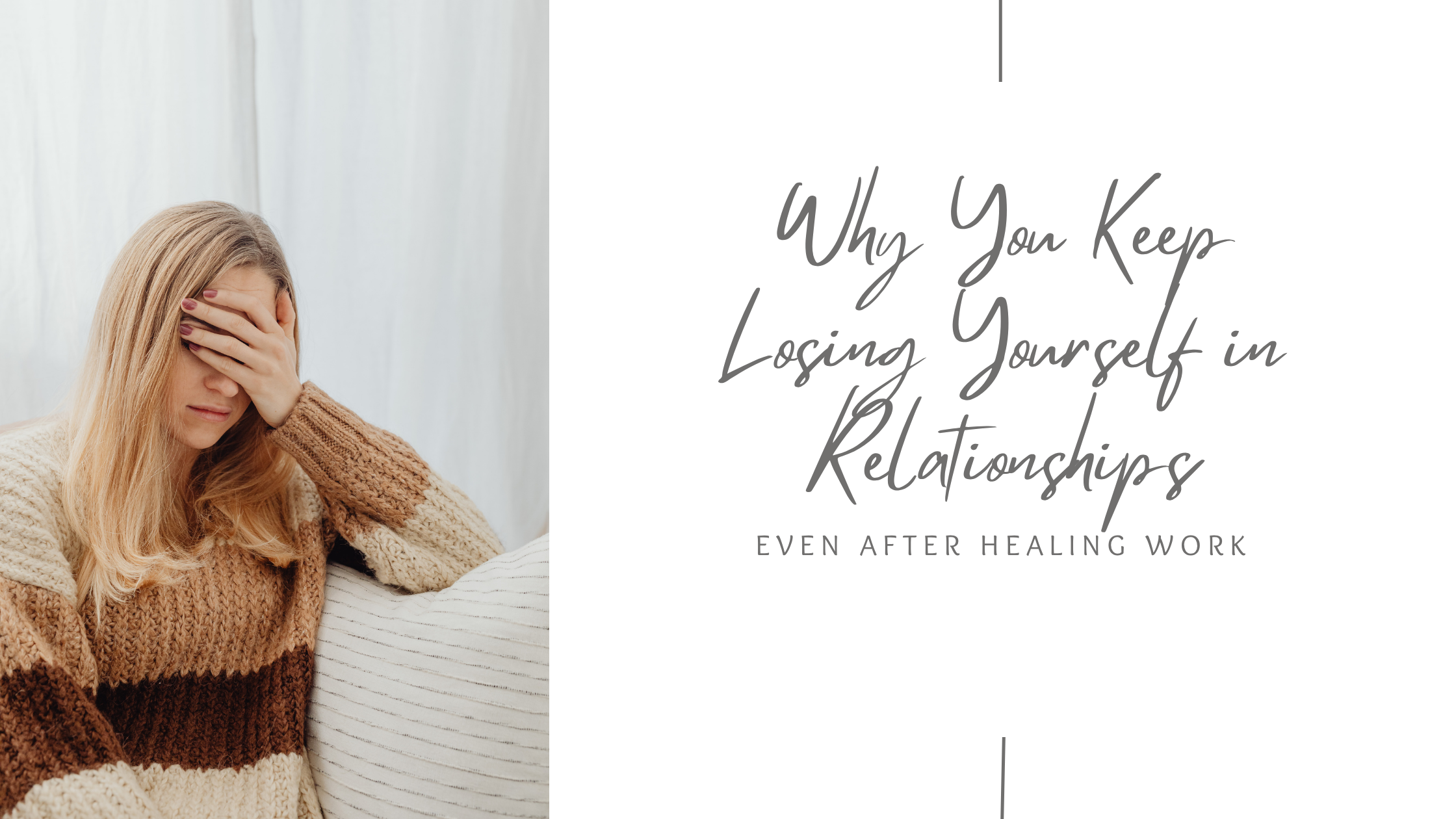
You may know this feeling well.
You start dating someone and slowly begin orienting around them. You think about their responses, moods, availability, or level of interest more than your own experience. You replay conversations. You second-guess yourself. You may stop expressing preferences, avoid conflict, or feel increasingly disconnected from your body and intuition.
And yet, outside of relationships, you seem to have it all together.
Many of the people I work with in my San Francisco therapy practice are insightful, capable, and emotionally intelligent. They’ve often already done years of therapy, personal growth work, or meditation. They may be successful professionally and deeply self-aware. But relationships still bring up anxiety, confusion, self-abandonment, or a painful feeling of losing themselves.
They’re often frustrated with themselves that they still can’t significantly change these patterns.
As a therapist offering somatic therapy, dating therapy, and psychedelic integration therapy in California, I hold that relational patterns are not just cognitive – at some point your nervous system learned that closeness required adaptation to keep you from becoming overwhelmed.
What Does “Losing Yourself” in Relationships Actually Mean?
Losing yourself in relationships does not necessarily mean becoming dependent on another person. In fact, many people who struggle with this are highly independent and high-functioning in other areas of life.
Instead, it often shows up as becoming overly focused on the other person while losing connection to your own internal experience. You may start monitoring how they feel, what they need, whether they are pulling away, or how to maintain connection. Over time, your own preferences, boundaries, anger, intuition, or embodied sense of truth can become harder to access.
Some people describe feeling more like themselves alone than in relationships. Others notice that once attraction enters the picture, they become anxious, hypervigilant, or emotionally disoriented.
This is especially common in people with attachment trauma or relational wounds from earlier family experiences. If closeness once required you to stay small, avoid conflict, manage another person’s emotions, or suppress your own needs, those patterns can continue long into adulthood — even when you consciously understand them.
Why Does This Happen Even After Years of Therapy or Healing Work?
Insight is important, but insight alone does not necessarily create embodied relational change.
Many people intellectually understand their patterns. They know they over-function, people-please, or become attracted to emotionally unavailable partners. But when they are inside an actual relationship dynamic, their nervous system responds automatically.
This is because attachment patterns are not simply beliefs. They are survival adaptations shaped through repeated relational experiences.
A child who grew up with criticism or emotional unpredictability may become highly attuned to other people’s moods. Someone raised around emotional volatility may learn to avoid conflict at all costs. Another person may confuse anxiety with attraction because intensity became associated with closeness or aliveness in early in life.
These strategies develop intelligently. They helped you maintain connection, belonging, or safety. Your nervous system is literally designed to work on automatic – below the level of your conscious mind or decision making - helping you avoid threat and orient towards safety.
But later in life, they can create exhaustion, resentment, confusion, or a chronic feeling of distress inside relationships.
Why Can Dating Feel So Dysregulating?
Dating naturally activates uncertainty, hope, longing, rejection sensitivity, and attachment needs. For many people, this becomes the perfect environment for old relational survival strategies to re-emerge.
You may notice yourself becoming preoccupied after intimacy, obsessing over communication, over explaining yourself, shutting down to avoid rejection, or feeling destabilized by inconsistency. Many high-functioning people are surprised by how emotionally consuming dating can become, especially when they otherwise feel grounded and competent in life.
Part of this is because dating bypasses many of our intellectual defenses. The body begins organizing around closeness, threat, and attraction long before the conscious mind fully catches up.
This is also why many people become exhausted by modern dating advice. Checklists, “red flags,” scripts, formulas, or hyper-analysis can sometimes increase vigilance rather than create clarity.
In my work as a dating therapist in San Francisco, I approach dating differently.
Rather than relying on checklists or external frameworks, our work helps you orient more deeply to yourself in relationship. Together, we explore how being with another person actually feels in your mind, heart, and body over time.
Instead of trying to analyze someone from the outside, you learn how to stay connected to yourself while relating, so discernment emerges more naturally and with less self-doubt.
We focus on helping you come into a deeper relationship with yourself so that attraction, boundaries, desire, and truth become more trustworthy. We explore the deeper terrain underneath your dating patterns, including who you are drawn to, what you tolerate, what you override, and where urgency, fantasy, loneliness, or fear may be driving the process.
In this work, we look at how relationship feels, not simply how it looks on paper.
Over time, your nervous system begins learning how to recognize emotional safety and how to stay connected to yourself during the dating process. Clarity comes less from monitoring the other person and more from remaining connected to your own embodied experience.
How Can Somatic Therapy and Psychedelic Integration Therapy Help?
Somatic therapy focuses not only on thoughts, but on the body’s experience of emotion, safety, connection, and protection.
In my work as a somatic and psychedelic integration therapist in San Francisco, we often slow down enough to notice the moment someone begins leaving themselves in relationship. Sometimes this appears as tightening in the chest, loss of breath, collapsing preferences, over-focusing on the other person, caretaking impulses, or difficulty accessing anger and boundaries.
These moments are important because they often happen automatically and outside conscious awareness.
Healing is not simply about becoming more confident or choosing “better” partners. Often, it involves increasing your capacity to stay connected to yourself while remaining emotionally connected to another person.
That requires growing your capacity to tolerate a certain degree of activation, or charge inside yourself – and therapy becomes a space where we track and practice that together.
Psychedelic integration therapy can also support this process by allowing the nervous system to expand. Attachment wounds, relational trauma, and emotional defenses can soften, and a new, healing experience of safety with another person can be felt, sometimes for the first time.
What Does Healing Actually Look Like?
Healing often looks less dramatic than people imagine.
It may look like slowing down enough to notice your own feelings while dating. It may mean expressing disappointment honestly instead of disappearing into accommodation. It can involve tolerating uncertainty without spiraling into hypervigilance, recognizing when attraction is driven by emotional activation rather than compatibility, or allowing yourself to have needs and preferences without shame.
For many people, healing also involves letting go. There can be sadness around how long survival strategies were necessary, how much energy went toward monitoring others, or how unfamiliar healthy connection may initially feel.
But there can also be tremendous relief, and a return of your life force that allows for more energy, confidence, nourishment, and playfulness in your life.
When people stop organizing entirely around another person’s approval, availability, or emotional state, they often experience more vitality, groundedness, and creativity. Relationships begin to feel less like performance or survival and more like genuine closeness.
Key Takeaways
Losing yourself in relationships is often a nervous system adaptation, not a personal weakness.
Many highly self-aware people still struggle with dating anxiety and self-abandonment.
Dating can activate attachment wounds and old survival strategies.
Somatic therapy helps people recognize how relational patterns live in the body and nervous system.
Healthy relationships require staying connected to yourself, not disappearing inside connection.
Clarity in dating comes less from hypervigilance and more from learning to trust your lived experience.
FAQs
-
This often develops as an adaptive strategy in earlier relationships where connection required monitoring others, suppressing needs, or prioritizing safety over authenticity. These patterns can continue automatically in adult relationships.
-
Yes. Somatic therapy helps people become more aware of how anxiety, attachment, and relational patterns show up in the body and nervous system, rather than only analyzing them cognitively.
-
Dating therapy focuses specifically on how relational patterns emerge in intimacy, attraction, attachment, communication, boundaries, and emotional connection. Rather than only discussing dating intellectually, the work often includes tracking your embodied experience and nervous system responses in real time, and practicing doing it differently.
-
Yes. I offer therapy and psychedelic integration therapy in San Francisco for individuals exploring relationship patterns, dating anxiety, attachment trauma, breakup and divorce healing, and personal transformation.